


The Sacroiliac Joint – Small Movement, Big Responsibility
The Anatomy of the Sacroiliac Joint
The sacroiliac joint (SIJ) connects the axial skeleton to the lower limbs and primarily provides stability and shock absorption rather than extensive movement. It plays a key role in transferring vertical loads from the spine to the legs and in managing and converting torque generated by the upper body. This load-transfer role explains why the SI joint is structurally designed for strength and control rather than mobility.
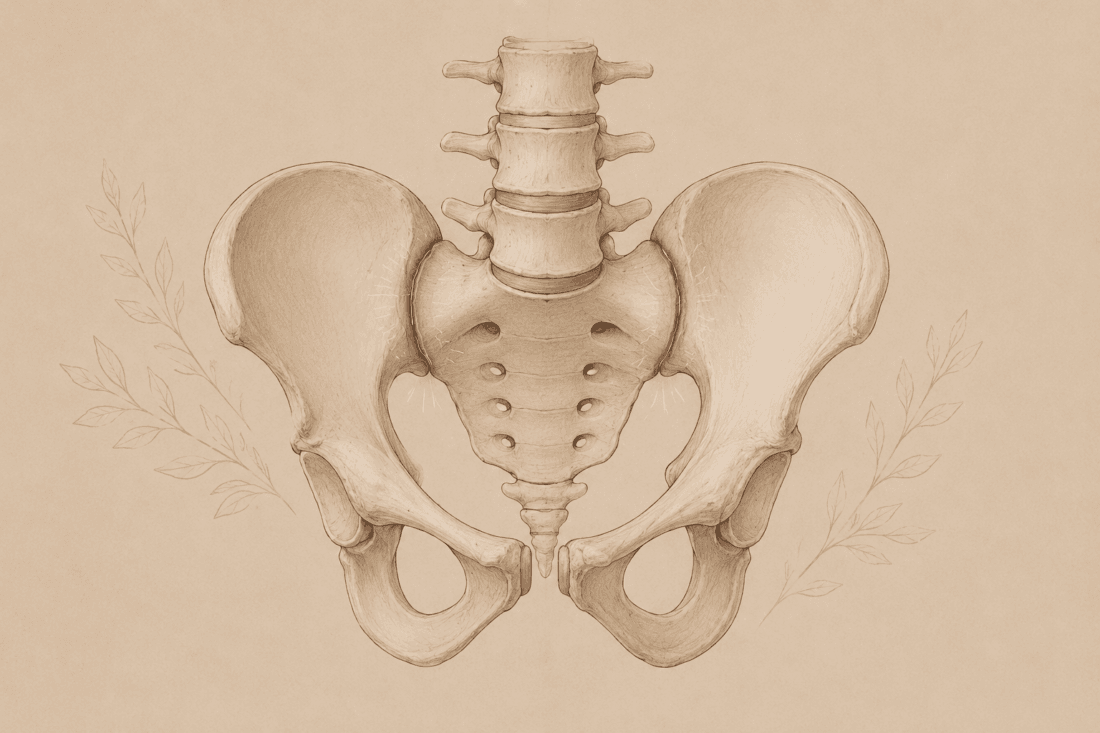
The sacroiliac joint is formed by the articulation between the sacrum and the ilium on each side of the pelvis. The sacrum is a triangular bone composed of five fused vertebrae, wedged between the two iliac bones. This wedge-like shape contributes to the joint’s inherent stability, especially during weight-bearing activities such as standing, walking, and lifting.
Anatomically, the SI joint is a synovial joint anteriorly and a syndesmosis posteriorly. The anterior portion contains a small synovial cavity with articular cartilage, while the posterior portion is reinforced by dense ligamentous structures. The articular surfaces are irregular and ridged, which increases friction and limits excessive movement, further enhancing stability.
Some of the ligaments of the sacroiliac joint are among the strongest in the body. The anterior sacroiliac ligament reinforces the front of the joint but provides relatively limited stability, while the posterior sacroiliac ligaments (short and long) offer major resistance to shear forces. Additional support is provided by the interosseous sacroiliac ligament, which is particularly thick and strong, as well as the sacrotuberous and sacrospinous ligaments. Together, these structures resist torsional and translational forces during daily and athletic movement.
Movement at the sacroiliac joint is minimal and measured in degrees rather than large ranges. The primary motions are nutation and counternutation of the sacrum relative to the ilium. Nutation involves anterior and inferior movement of the sacral base, while counternutation refers to posterior and superior movement. These subtle motions are influenced by posture, breathing, load, and muscle activity and are essential for efficient force transmission rather than flexibility.
Muscular relationships surrounding the SI joint further support its function. Muscles such as the gluteus maximus, latissimus dorsi, multifidus, pelvic floor muscles, and deep abdominal muscles contribute to force closure. Force closure refers to the active stabilization of the joint through muscular tension, complementing the passive stability provided by bone shape and ligamentous support.
From a movement and Pilates perspective, the sacroiliac joint serves as a stable yet adaptable link between the trunk and the legs. Rather than attempting to mobilize the SI joint directly, effective movement practices focus on optimizing load transfer, coordination, breathing, and balanced muscular support around the pelvis and trunk.
Understanding the anatomy and function of the sacroiliac joint allows teachers and practitioners to move beyond fear-based explanations and toward a more functional, evidence-informed approach to pelvic and spinal health.
Join us for a free lecture about the SI joint, Wednesday, February 11th, 2026 11:30AM London time. Check your time zone here
Reserve your spot here