


Special Populations Primary School Teachers
In Pilates, it is possible to cater to all kinds of Special Populations, and there is much literature to be found on this subject. Pilates to improve your running technique, how Pilates can improve posture amongst the younger generation, Pilates for Mothers and Babies, and Pre-natal Pilates. The list just keeps on going. But what about the amazing group of people who labor day in, day out in our Schools, providing the best possible education for our young children? What about teachers?
Having been a Primary School teacher myself for 12 years, I have experienced many of the stresses, strains, and physical discomforts that can result from working with young children in a high-pressure environment. Not enough time to exercise, painful shoulders and upper back, fatigue, stress, and an overall lack of physical and mental well-being. After discovering Pilates 3 years ago and completing my Instructor’s Certification in April, I can now see how Pilates can benefit all teachers of young people. It certainly turned my life around.
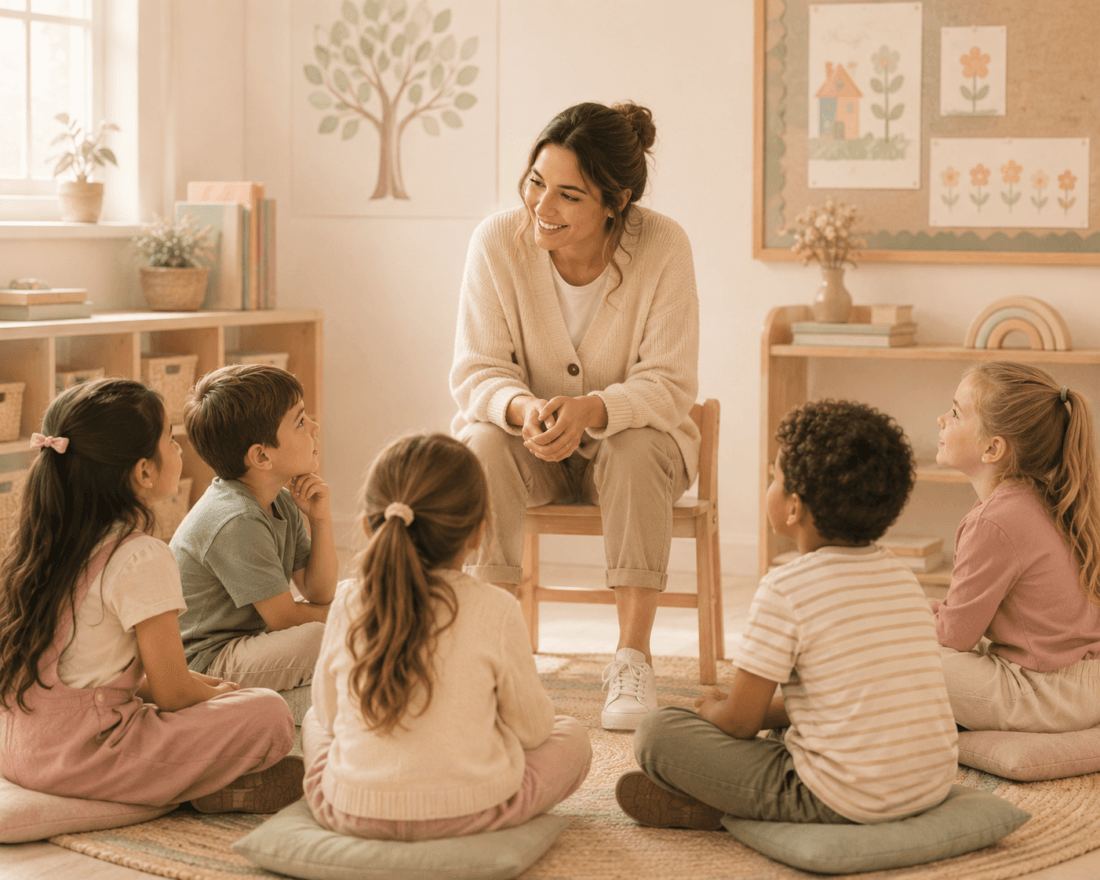
When was the last time you entered a Nursery or Key Stage 1 classroom? Have you seen the size of the chairs and tables? They are tiny! I have recently spent time observing in such classrooms, and I was shocked by how much time adults spent hunched over on these tiny chairs and tables, talking and learning with the children. Kyphosis (an abnormal, convex curvature of the spine, with a resultant bulge at the upper back) appears to be rife amongst teachers who work with small children.
Sitting at the tiny tables and chairs repeatedly or for long periods can cause the spine to curve unnaturally and the shoulders to hunch, making certain muscle groups tight and others unused. The spinal extensors can become weak, further worsening spinal alignment, and the muscles at the front of the chest can become constricted, causing the shoulders to hunch and breathing to be impaired. I believe that, with even just two Pilates classes a week featuring spinal extension exercises, young children could learn to use their core muscles correctly to support their posture when seated at uncomfortably low tables and chairs, and in everyday life.
One of the biggest complaints from teachers about their job is stress. People who become teachers are naturally very conscientious and want their students to achieve as much as possible. They set very high standards for themselves and the young people they work with. This level of commitment and perseverance does take its toll on the body and mind, leading to unnaturally high levels of stress.
In his book Return to Life Through Contrology , Joseph Pilates (1945) wrote that such a body freed from nervous tension and over-fatigue is the ideal shelter provided by nature for housing a well-balanced mind that is always fully capable of successfully meeting all of the complex problems of modern living. (p. 22). If teachers were to practice Pilates regularly, they could begin to experience Pilates as “…a system of physical and mental conditioning that can enhance your physical strength, flexibility, and coordination as well as reduce stress, improve mental focus, and foster an improved sense of well-being.” (Pilates Anatomy: Your illustrated guide to mat work for core stability and balance, Rael Isacowitz & Karen Clippinger, 2011, p. 1).
I teach a number of classes for teachers throughout the week in various school environments. My key objective during these sessions is relaxation. This sense of relaxation can be achieved primarily through the breath. I try to spend some time at the beginning of each class (whether with beginners or more experienced practitioners) focusing on the breath. Joseph Pilates believed the breath was central to enhancing the mind-body connection, which is key when encouraging teachers to set aside the pile of paperwork still on their desks and spend an hour focusing on themselves.
Teachers tend to carry their stress in their shoulders, which creates unnecessary tension and overuse of the trapezius and levator scapulae muscles. My classes with teachers always contain the following fundamentals: cervical moves, head float, and rotating arms. This is to minimize patterns of muscular tension and increase the awareness of which muscles should be working and which ones should be relaxing. It allows my Pilates students to feel the natural movement and alignment of their head, arms, and shoulders without overworking the trapezius and deltoid muscles.
Teaching core engagement and how this can be used to support functional movements in everyday life features highly in my classes with primary teachers. Teachers spend a large proportion of their day standing. When I was working as a full-time primary teacher, the amount of time spent on my feet created strain and discomfort in my lower back. By developing an awareness of imprinting and incorporating exercises such as hip/knee actions, single leg circles and single leg stretch into a Pilates program for teachers, my students learn how to use their abdominals correctly to control movements of the pelvis and to maintain pelvic and spinal stability whilst standing, walking, running, and even playing.
Throughout my classes with teachers, I try to include some meditation and mindfulness. I find music very beneficial and have received many positive comments from my students about it. I tend to use music that is upbeat enough to energize and enthuse people during their practice, yet relaxed enough to help them ‘let go’ and focus on the body, mind, and breath. Using phrases such as ‘thank yourself for being here today’, ‘be grateful for this time you have dedicated to your own well-being’ are very useful to help teachers relax and rid themselves of thoughts of work. I always end my sessions with teachers with a short mindfulness and relaxation session. I ask clients to focus on their breath, noticing what part of the body they are breathing most strongly into. To notice how their body feels, particularly compared to the start of class. To note the feeling of weightlessness of the head on top of the shoulders, and the feeling of relaxation yet energy in the body. The room full of smiles and relaxed faces from the teachers, and the knowledge that I have assisted in this, is a phenomenal feeling.
On occasions (particularly towards the beginning or end of term), my class numbers with teachers tend to be very low. After some discussion with many of my teacher-students, I discovered that many of them felt guilty about coming to class when they could have been getting on with one of the numerous tasks still to do in their classroom. One Year 3 (7-8 year olds) teacher stated that by doing a pile of marking, completing a particularly tricky email to a parent, or finishing some paperwork she could physically tick something off her ‘to do’ list, yet spending an hour focusing on developing her physical and mental well-being was not even on the ‘to do’ list. I wish to encourage all teachers, in fact all people, to put themselves right at the top of their ‘to do’ list, starting with regular Pilates sessions.
[border ]