


Small Changes Matter More Than You Think
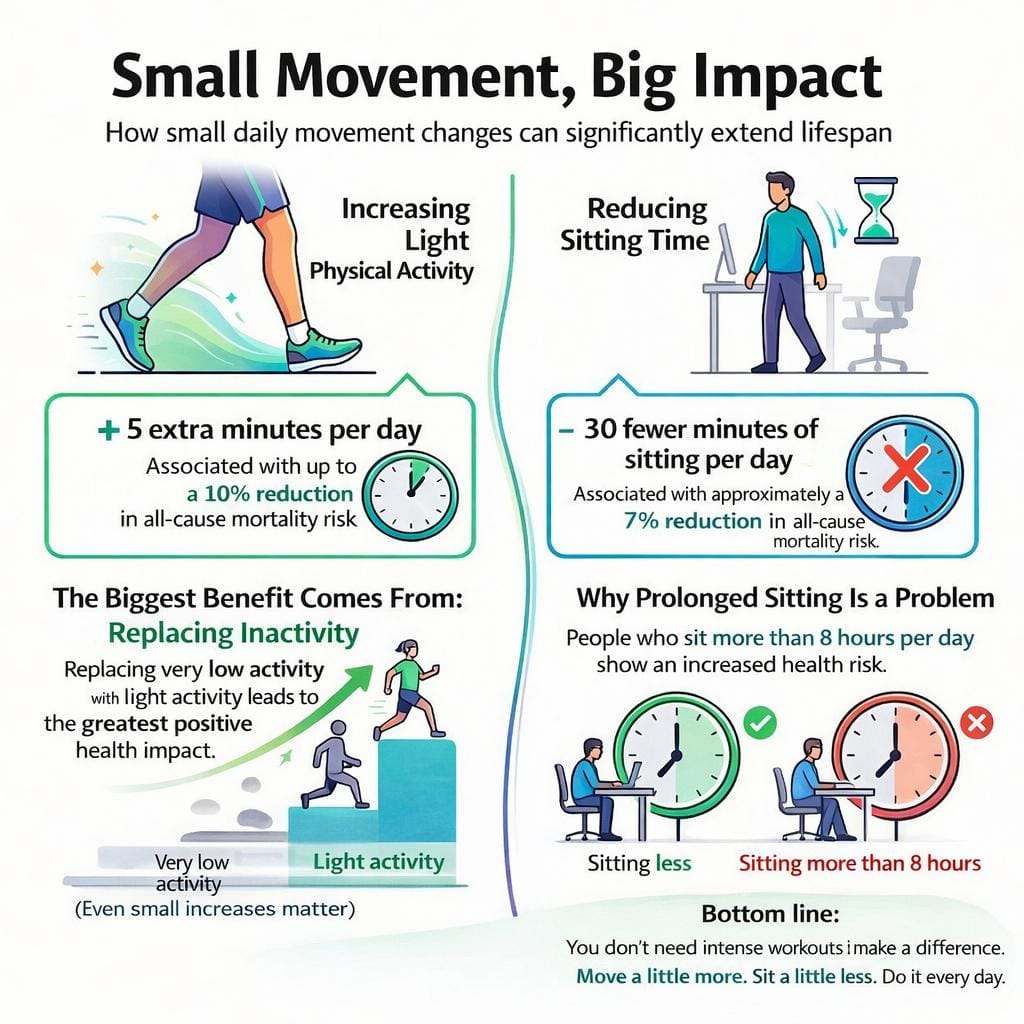
Over the past decade, researchers have begun to move beyond simple questions like “Do people who exercise live longer?” Instead, they have asked deeper questions about how everyday movement patterns shape health and longevity. The widespread use of wearable devices has allowed scientists to measure real-life behavior rather than relying on memory or self-report.
Three key studies — from 2017, 2019, and 2020 — together have reshaped how we think about movement, sitting, and health.
Lear et al., 2017 — Sitting time as an independent health risk
This global study looked at physical activity and sitting behavior across many countries and populations. What made this research important was that it separated exercise from sedentary behavior, rather than assuming they were simply opposites.
The researchers found that:
- Sitting for more than about eight hours per day was associated with a higher risk of cardiovascular disease and premature death.
- This risk was particularly pronounced in people who were otherwise inactive.
- Being physically active helped reduce the risk — but did not fully cancel out the harm of prolonged sitting.
This was a crucial shift in thinking. It suggested that sitting is not just the absence of exercise — it is its own health risk. Even someone who goes to the gym regularly may still be at risk if they spend most of their day sitting.
In practical terms, this study highlighted that:
- We need to care about how long we sit, not just how much we exercise.
- Breaking up sitting time is just as important as structured workouts.
- Movement needs to be woven into daily life, not confined to one hour of training.
Ekelund et al., 2019 — Replacing sitting with light movement
Building on this idea, Ekelund and colleagues conducted a large meta-analysis, pooling data from multiple international studies that used wearable accelerometers to track movement.
Their key contribution was examining what happens when people replace sitting with light physical activity.
They found that:
- Even very gentle movement — such as slow walking, standing, or light household activity — was associated with meaningful reductions in mortality risk.
- The greatest benefits occurred in people who were most sedentary at baseline.
- You did not need vigorous exercise to see health improvements — simply reducing sitting and increasing light movement made a measurable difference.
This study reframed physical activity as a continuum, rather than a binary of “exercise vs. not exercise.” It suggested that health gains accumulate from many small moments of movement across the day.
From a movement perspective, this supports the idea that:
- Frequent, low-intensity movement is just as important as structured training.
- The body thrives on regular, varied motion rather than long periods of stillness.
- Everyday activities — walking, standing, stretching, shifting weight — are not trivial; they are foundational to health.
Saint-Maurice et al., 2020 — Steps, not speed, predict longevity
The 2020 study by Saint-Maurice and colleagues, published in JAMA, used objective step data from wearable trackers in thousands of U.S. adults aged 40 and older.
This study was particularly powerful because it measured real daily steps over time, rather than relying on questionnaires.
Their main findings were:
- People who took more steps per day lived longer.
- Mortality risk decreased steadily as step counts increased, especially when moving from very low activity to moderate activity.
- Importantly, walking speed did not significantly predict mortality once total steps were accounted for.
One striking comparison from the study showed that:
- Adults averaging around 8,000 steps per day had roughly half the mortality risk of those averaging about 4,000 steps per day.
This finding shifted the focus from “working out harder” to simply moving more across the day. It suggested that consistency and volume of movement matter more than intensity.
For everyday life, this means:
Step count can be a simple, accessible proxy for overall daily movement.
You don’t need to walk fast to gain health benefits.
Regular, gentle movement throughout the day may be more protective than one intense workout followed by long sitting.
Instead of asking, “Did I work out today?” a more meaningful question becomes, “How did I move throughout my day?”
Here are practical ways to weave movement into daily life:
- Add one short walk each day, even if it’s only five to ten minutes.
- Stand up at least once every hour — set a gentle reminder if needed.
- Take phone calls on your feet or while walking.
- Choose stairs over elevators when possible.
- Park a little farther from your destination and walk the rest.
- Get off public transport one stop earlier and walk.
- Move while brushing your teeth — shift your weight, sway gently, or walk in place.
- Do gentle hip circles, ankle pumps, or shoulder rolls while standing in line.
- Pace while thinking, reading, or problem-solving.
- Replace one seated coffee break with a standing or walking one.
- Take two or three minutes of movement between meetings.
- Stretch or breathe deeply before sitting back down.
- Turn household chores into “movement snacks” — tidying, sweeping, watering plants, or organizing a drawer.
- If you work at a desk, alternate between sitting and standing.
- If you watch TV, stand up during commercials or between episodes.
None of these actions are dramatic. None require special equipment or a gym membership. Yet when repeated day after day, they accumulate into meaningful health benefits — for your heart, metabolism, mobility, mood, and long-term wellbeing.
Movement is not only something you “do” in a class or a workout. It is a way you live.
At Body & Flow, we believe that intelligent, frequent, gentle movement is one of the most powerful tools for lifelong health.
Small choices, made consistently, create big change.
Move a little more. Sit a little less. Do it every day.